

In This Article
- What is a small language model and why does the size difference actually matter?
- Why comparing small AI to giant AI may be asking the wrong question entirely
- How an orchestra metaphor cracked open a better way to think about personal AI systems
- What a personal AI appliance might look like when the DIY phase is finally over
- Why the most valuable AI in your life might not be the most powerful one ever created
Several months ago I watched a YouTube interview with a man whose name I never caught, whose company I cannot remember, and whose exact words have since dissolved into the general noise of everything I consume online. But one idea survived the forgetting. He said AI didn't necessarily have to keep getting bigger. At the time I filed it away and moved on, because everything visible in the AI landscape was pointing in precisely the opposite direction. Bigger models, bigger chips, bigger data centers, bigger checks written by people with more money than most countries. The idea seemed almost quaint. Then I started tinkering, and quaint started looking like prescient.
The Day a Small Model Surprised Me
My experiments eventually led me to Google's Gemma 3 12B, which is not a frontier model by any measure the industry would recognize. It was not humming away in a billion-dollar data center somewhere next door or in the desert gobbling up electricity and water. It was running on a $700 used gaming computer with a gpu with 12G of vram. That is a sentence worth sitting with for a moment, because it describes something genuinely new in the history of computing.
The model couldn't do everything the largest cloud systems can do. Nobody is pretending otherwise. But the gap between what it could do and what I expected it to do was wide enough to stop me cold. It brought the forgotten YouTube conversation back to the front of my mind. Maybe that man had been onto something real. Maybe smaller wasn't a consolation prize. Maybe it was a different game entirely.
What a Small Language Model Actually Is
Most of the AI receiving breathless coverage today runs on large language models, which the industry abbreviates as LLMs. A small language model, usually called an SLM, works on many of the same fundamental principles but requires a fraction of the computing power. That one difference changes almost everything about what you can do with it and where it can live.
A giant AI generally lives somewhere else. It lives on somebody else's hardware, behind somebody else's terms of service, subject to somebody else's decisions about what it will and won't discuss. A sufficiently small AI can live with you. It can run on a machine you own, in a space you control, with information you choose to share and information you choose to keep to yourself. That distinction became more interesting to me than any benchmark score I'd ever read.
Asking a Better Question About Intelligence
The natural first instinct when you encounter a smaller AI is to compare it directly to the largest one you've used. Which is smarter? Which reasons better? Which gives the more impressive answer? It's an understandable question. It's also probably the wrong one.
My calculator doesn't need to understand Shakespeare. My word processor doesn't need to diagnose my car. A hammer is not a worse tool than a surgical scalpel simply because the scalpel costs more and requires more training to operate. Different tools exist because different jobs have different requirements. At some point I stopped asking how powerful my small local model was and started asking how powerful it needed to be for the specific thing I was asking it to do. That was the turning point. The question changed shape, and so did the answer.
The Model Is Only One Ingredient
As the experiments continued, I discovered that the language model itself is only one component of a useful AI system. There are techniques for giving a model access to your own information without retraining it from scratch. There are methods for specializing models toward particular domains. There are ways to compress models so they run efficiently on consumer-grade hardware. And there are approaches for coordinating multiple AI components so each one handles the work it's best suited for. The terms, for anyone who wants to dig further, are RAG, LoRA, quantization, local inference and AI orchestration.

The specific mechanics matter less than the insight they produce. A useful AI system can be considerably greater than the model sitting at its center. That's not a technical footnote. That's the whole plot. The model is the violin. The system is the symphony. Mistaking one for the other is how you end up drawing the wrong conclusions about what small AI can and cannot do.
The Orchestra That Changed How I See This
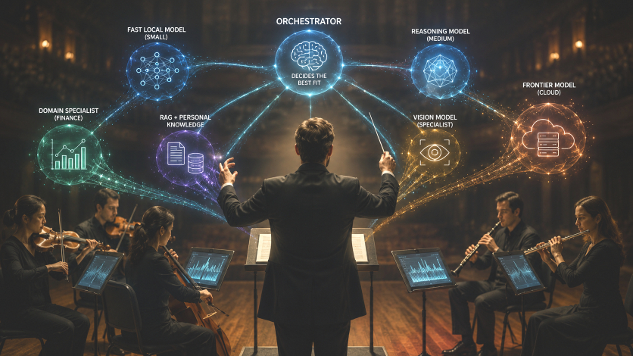
I started thinking about it as an orchestra, which is not a particularly original metaphor but turns out to be a useful one. You don't hire a hundred trumpet players because the trumpet happens to be the loudest instrument in the room. Different instruments perform different jobs, and the performance only works because something coordinates them. A conductor decides what each part of the ensemble should do and when.
AI could work the same way. A very small model handles the easy, routine tasks. A somewhat larger one takes on harder problems. Specialized systems work with financial records, household data or years of personal research. And when something genuinely requires the capabilities of one of the enormous frontier models, the system reaches out to the cloud to fetch that power. The conductor in this arrangement simply asks one question before routing any request: what does this job actually require? Then it reaches for the smallest capable resource that can handle it well. That architecture produces something neither a tiny local model nor a massive cloud service could produce alone. It produces a system that is both personal and powerful, depending on what the moment demands.
The Shape of a Personal AI
At some point in all of this thinking, I realized I had quietly stopped thinking about small language models and started thinking about something more personal. My own AI. An artificial intelligence that primarily runs on hardware I control, that knows the things I choose to let it know, and that serves the life I'm actually living rather than an averaged-out statistical portrait of everyone who has ever typed a query into a search box.
It would know my projects and my household information. It would know my financial records and my interests. It would know the books I've read and the research I've been conducting for years. It would remember an idea I abandoned two years ago and recognize when that idea becomes relevant to something I'm working on today. It would notice when an insurance premium keeps quietly climbing. It would know when an appliance was purchased and where the warranty lives. It could help me learn because it would remember what I already understand, which means it wouldn't waste my time explaining what I already know. It might eventually incorporate health data from doctors, labs and wearables, kept behind privacy protections I set and control. It wouldn't need to know everything in the world. The giant AI systems handle that. Mine would need to know my world.
Where Personal AI Stands Right Now
At the moment, assembling a system like this requires genuine technical effort. Models have to be downloaded and configured. Hardware choices matter in ways that aren't obvious at first. Different software components have to be coaxed into communicating with each other. The whole thing reminds me, frankly, of early personal computing, which was not a consumer product in any meaningful sense before someone decided to make it one.
Early computer owners didn't open a box and immediately begin streaming movies and making video calls and accessing billions of web pages. They tinkered. They figured things out through trial and error. The same was true of the early Internet, which was a hobbyist's playground long before it became the infrastructure that runs the modern world.
Technologies that eventually become ordinary often begin as projects that technically curious people assemble themselves, in pieces, from parts that weren't originally designed to fit together. Personal AI appears to be at that stage right now. The pieces exist. People are building with them. The interesting question is what happens when someone packages those pieces for everyone else.
An Appliance Waiting to Be Invented
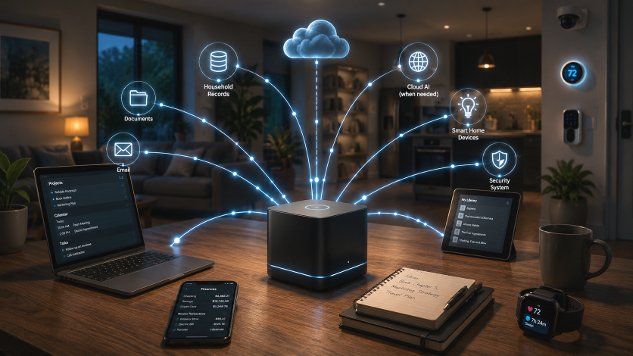
Picture the DIY project becoming a box. Not a humanoid robot with a friendly face, because we seem to have a cultural habit of imagining AI in the most theatrical form possible when the practical form is usually much quieter. Perhaps it's simply a small device that sits somewhere in the house. You plug it in. Your computers, phones and other devices communicate with it. You decide what information it can access. Most everyday AI work happens locally, on your hardware, without a single packet of your personal data traveling to a server you don't control.
When the task genuinely exceeds what lives in that box, the system reaches outward to a larger cloud service, uses what it needs and returns with the answer. Local first. Cloud when necessary. Instead of every question you ask automatically traveling to somebody else's computer before it comes back to you, your own AI becomes the first stop. That is a fundamentally different architecture from the one most people associate with AI today, and it allocates control in a fundamentally different direction.
The Family Doctor and the World's Greatest Physician
The largest AI in the world will almost certainly know more than any personal AI running on home hardware. That statement is true and also beside the point. The world's greatest physician knows more about medicine than your family doctor. That advantage does not make your family doctor less valuable. Your family doctor knows something the world's greatest physician doesn't know: you. Your history, your patterns, your previous concerns, the way you describe symptoms, the things you tend to ignore until they become serious. That knowledge has a different kind of value than encyclopedic breadth. It has the value of continuity and context.
Something similar could happen with artificial intelligence. The most valuable AI in your daily life might not be the most intelligent model ever created by the most well-funded lab on the planet. It might be the one that has been paying attention to you specifically. The one that remembers what you were working on last spring, knows how you think about problems and understands the shape of the life you're actually trying to live. That is what small language models make increasingly practical. Not a replacement for giant AI. A complement to it. A companion that is yours in a way that a shared cloud service simply cannot be.
From Personal Computing to Personal Intelligence
The personal computer put computing power into individual hands for the first time. The Internet connected those individuals to more information than any library in human history had ever contained. The smartphone compressed that access into something small enough to carry in a pocket. Cloud AI is now giving millions of people access to machine intelligence that would have seemed like science fiction twenty years ago. Each of those steps moved capability closer to the individual. Small AI may represent the next step in that same direction: bringing some of that intelligence home, onto hardware you own, into a system that serves you rather than harvesting you.
I still don't remember who that man was on YouTube. I couldn't pick him out of a lineup or name the company he was building. But I remember what I took away from his few minutes on a screen I was probably half-watching while doing something else. Think smaller. At the time I assumed he was talking about chip architecture or model efficiency or some other technical problem I didn't fully understand. Now I think he was pointing me at something much larger than any of that. The biggest change in artificial intelligence may not arrive when someone builds a model so vast it can barely be imagined. It may arrive when ordinary people can have one of their own.
Coming Next: What Happens When Your AI Really Knows You?
Having your own AI is only the beginning. What happens when that AI remembers your projects, understands your finances, knows what you've been trying to learn, recognizes patterns you've missed, and develops a history with you that stretches across years? In the next article in this series, we'll look beyond small language models to something potentially much more consequential: an artificial intelligence that doesn't just know about the world, but actually knows you.
About the Author
 Robert Jennings is the co-publisher of InnerSelf.com, a platform dedicated to empowering individuals and fostering a more connected, equitable world. A veteran of the U.S. Marine Corps and the U.S. Army, Robert draws on diverse life experience, from real estate and construction to building InnerSelf.com with his wife, Marie T. Russell, bringing a practical, grounded perspective to life's challenges. InnerSelf grew from InnerSelf Magazine, founded by Marie T. Russell in 1985, which became InnerSelf.com in 1996. Decades later, InnerSelf continues to inspire clarity and empowerment.
This article is licensed under a Creative Commons Attribution-NonCommercial-NoDerivatives 4.0 License. You may share it with attribution to Robert Jennings, InnerSelf.com, and a link back to the original article at InnerSelf.com. Commercial use and derivative works are not permitted without permission.
Recommended Books
The Age of Surveillance Capitalism by Shoshana Zuboff — A deeply researched examination of how personal data became the raw material of a new economic order, and what reclaiming control of that data might require.
The Alignment Problem by Brian Christian — An accessible exploration of how AI systems learn what we value and why building AI that genuinely serves individuals rather than aggregates is harder than it looks.
Life After Google by George Gilder — A provocative argument that centralized cloud architecture is nearing the end of its dominance and that the future of computing belongs to more distributed, personal systems.
Article Recap
Small language models running on personal hardware represent a genuine shift in who controls AI and whose life it actually serves, moving artificial intelligence from a centralized cloud service toward something closer to a personal AI assistant you own and configure yourself. The case for small AI at home is not that it outperforms the largest models available, but that it offers continuity, personal context and privacy that no shared cloud service can replicate. As local AI inference tools improve and personal AI appliances move from DIY hobbyist projects toward consumer products, the question of how to run AI locally on your own hardware may become one of the most practically important technology decisions ordinary people face.
#SmallLanguageModels #PersonalAI #LocalAI #AIPrivacy #SLM #AIAtHome #FutureOfAI #PersonalComputing #AIOrchestration #MachineLearning