
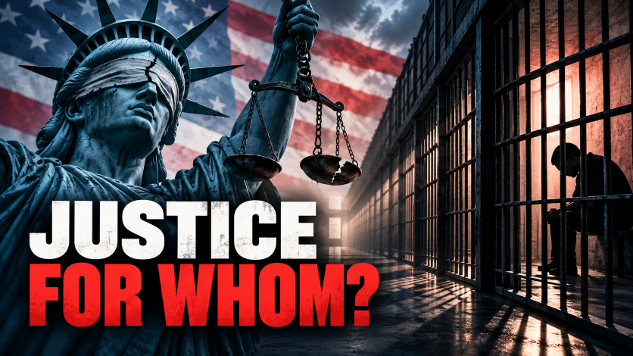
In This Article
- How does American justice actually work when you cannot afford to pay for it?
- What do death row exoneration rates tell us about who we are willing to execute?
- Why are there more mentally ill people in US prisons than in hospitals?
- What does the war on drugs really mean for property rights and civil liberties?
- Are we repeating patterns from history that we swore we never would?
There is a particular kind of arrogance that comes naturally to nations that believe their own press releases. The United States has spent decades presenting itself as the global sheriff of human rights, wagging a finger at China, Russia, and anyone else whose conduct offends the international community. It is a fine hobby, if you can afford it. But when nearly half the people on death row in major American states turn out to be innocent, the moral high ground starts seeming more like a mudslide.
The Price Tag on Justice
You may have a right to a lawyer, but that does not give your lawyer enough time to defend you. Public defenders can be carrying more cases than they have the staff or money to handle properly. A careful review of your case should be part of the job. Instead, an overworked attorney may have to fight to find time for it. I do not fault the dedicated lawyers trying to make this work. I want to know why we promise poor people a defense and then fail to provide the resources it takes.
The country has more lawyers per capita than any other nation on earth. And and it is still desperately short of lawyers who are primarily concerned with justice rather than billing hours. That gap is where innocent people fall through.
Death Row and the Arithmetic of Innocence
Consider the numbers out of Illinois. Over a span of twenty-one years, eleven people on death row were exonerated and walked free. In that same period, eleven people were executed. If you are comfortable calling that a coincidence, you have a higher tolerance for risk with other people's lives than most of us do. But Illinois was not alone. Across Florida, Illinois, Georgia, Arizona, Oklahoma, New Mexico, Louisiana, California, and Ohio, 139 people were executed. Another 62 were exonerated. That is nearly fifty percent of the total. Nearly half.
Texas was excluded from that calculation, not to protect Texas, but because including it would have made the numbers even harder to sit with. Texas has executed roughly one and a half times as many people as all those other states combined. The pace alone should give anyone pause.
We used to say it was better to let ten guilty men go free than convict one innocent man. I wonder how much that promise means to an innocent person sitting in prison. We still repeat the saying. Do we give it much thought when someone says they have been wrongly convicted?
Mental Illness Behind Bars
People with mental illness end up in jail, where locking the door does nothing to treat what put them in trouble. We once built hospitals to provide care. Some were places nobody should have been sent, and closing an institution could be justified. But what treatment was waiting outside? If the answer was little or none, we should hardly be surprised when a prison became the place someone finally received attention.
What replaced that approach was a corrections system that has neither the tools nor the mandate to treat mental illness, only to contain it. Putting a person with schizophrenia in a cell does not cure schizophrenia. It makes it worse. The environment almost guarantees that. And when those people are eventually released, they go back into communities more damaged than when they arrived, without treatment, without support, and often without housing.

Who Can Afford to Stay Out?
A defendant with money can pay a lawyer to spend time going through the evidence. Someone without it may have to wait while a public defender works through a pile of other cases. Being innocent does not make that wait any easier. Poor people and minority communities bear much of the burden of imprisonment. Before we boast about being tough on crime, I would like to hear what chance we gave them to defend themselves.
The pattern has historical company that nobody wants to name out loud. The concentration of the powerless, the disenfranchised, and the mentally ill into prison populations that function outside normal civic life is not a new idea. It has been tried before, by governments that the United States spent considerable blood and treasure defeating. History has a way of coming back when people stop paying attention.
What Happened to Property Rights?
The war on drugs brought more policing and mandatory minimum sentences. It also gave governments a way to take property from people who had not been convicted of a crime. In some civil forfeiture cases, the owner need not even be charged. Then comes the job of trying to get the property back. That can mean hiring a lawyer and paying to challenge the government’s case. We used to make quite a fuss about property rights. Apparently, an owner may now have to spend more money defending them than the property is worth.
That is not a feature of a free society. It is the kind of policy that shows up among regimes whose human rights records we publicly deplore. The drug problem in the United States is real, and it is serious. But putting an enormous portion of the poor population behind bars has not solved it. It has mostly just moved suffering from one visible place to another less visible one.
What We Traded Away and What We Got for It
Americans gave up a remarkable collection of liberties in exchange for a feeling of safety. Not actual safety — the feeling of it. The security theater of mass incarceration reassures people who do not have to live inside the system that something is being done. The people living inside it know better. They know that safety and justice aren't the same thing, and that a country can have very elaborate mechanisms for punishing people while delivering very little of either.
Who gains when these problems go unfixed? Who saves money by leaving a public defender with too many cases? Who gets to keep property taken from someone never charged with a crime? I would like those answers before hearing another American lecture on human rights abroad. We ought to be willing to examine what we do to people at home.
How Long Do We Wait?
I think of the brown shirts when I hear people explain away another abuse of government power. I am not suggesting that every injustice is the same as what happened in Germany. I am asking how much we will accept before we object. A person loses property. Someone else cannot get a proper defense. After a while, we grow accustomed to hearing about it.
What happens to the people involved while the rest of us get used to the news? They still have to live with what was done to them. We can ask questions now, press our officials for answers, and insist that rights apply to people who have neither money nor influence. Or we can leave our children to ask why we waited.
I would rather make a nuisance of myself now than explain later why I kept quiet.
About the Author
 Robert Jennings is the co-publisher of InnerSelf.com, a platform dedicated to empowering individuals and fostering a more connected, equitable world. A veteran of the U.S. Marine Corps and the U.S. Army, Robert draws on diverse life experience, from real estate and construction to building InnerSelf.com with his wife, Marie T. Russell, bringing a practical, grounded perspective to life's challenges. InnerSelf grew from InnerSelf Magazine, founded by Marie T. Russell in 1985, which became InnerSelf.com in 1996. Decades later, InnerSelf continues to inspire clarity and empowerment.
This article is licensed under a Creative Commons Attribution-NonCommercial-NoDerivatives 4.0 License. You may share it with attribution to Robert Jennings, InnerSelf.com, and a link back to the original article at InnerSelf.com. Commercial use and derivative works are not permitted without permission.
Recommended Books
The New Jim Crow: Mass Incarceration in the Age of Colorblindness by Michelle Alexander — A groundbreaking examination of how the American criminal justice system functions as a system of racialized social control.
Just Mercy: A Story of Justice and Redemption by Bryan Stevenson — A deeply personal account of fighting for the wrongly condemned and the broken parts of the justice system that put them there.
Imprisoning Communities: How Mass Incarceration Makes Disadvantaged Neighborhoods Worse by Todd R. Clear — A rigorous look at how high incarceration rates destabilize communities rather than protect them.
Article Recap
The American criminal justice system disproportionately targets poor, minority, and mentally ill populations while high death row exoneration rates and civil asset forfeiture laws expose a pattern of institutional injustice that contradicts the nation's stated commitment to human rights. When nearly fifty percent of death row inmates in examined states were later exonerated, and property can be seized without a charge being filed, the gap between American ideals and American practice demands urgent public reckoning.
#CriminalJusticeReform #MassIncarceration #HumanRightsCrisis #DeathRowExonerations #JusticeSystem #CivilRights #MentalHealthInPrisons #WarOnDrugs #SystemicInjustice #AmericanJustice